You’ll get reliably crisp, evenly cooked sweet potato wedges by controlling cut size, surface dryness, oil quantity, and air-fryer temperature. Use firm tubers, ½-inch wedges, and a brief toss with minimal oil and seasoning to promote browning. Follow precise timing and circulation strategies to achieve a perfect exterior and tender interior…
Ingredients and Measurements
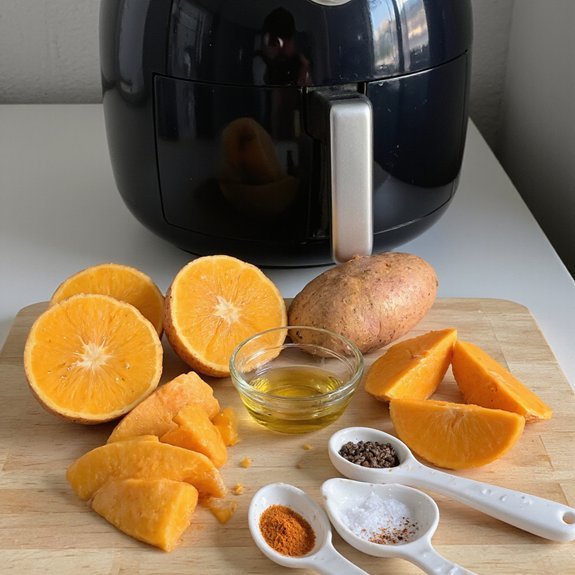
You’ll need 1.5–2 pounds (about 3 medium) sweet potatoes, scrubbed and cut into wedges approximately 1/2 inch (12–14 mm) thick; weigh to confirm mass. Add 1–2 tablespoons neutral oil for surface coating, 1 teaspoon fine salt, 1/2 teaspoon ground black pepper, and optional 1/2 teaspoon smoked paprika for flavor modulation. For crisp exterior without excess fat, you’ll toss wedges in a single layer with minimal oil. These measurements balance texture, cook time, and nutritional retention to highlight sweet potato benefits, including beta‑carotene preservation and controlled glycemic response. Follow uniform dimensions and measured seasonings as core preparation techniques to guarantee reproducible results and scalable batch sizes for innovative recipe iterations. Document weight, slice thickness, and oil ratios for iterative refinement and data-driven recipe development now.
Equipment You’ll Need

With the sweet potatoes weighed and cut to 12–14 mm wedges, gather equipment that matches the measured approach: a convection air fryer with adjustable temperature and timer (a 3–4 qt / 3–4 L basket handles 1.5–2 lb in a single, minimally crowded layer), a digital kitchen scale accurate to 1 g, a sharp chef’s knife or mandoline set to 12–14 mm, a large mixing bowl for even tossing, silicone‑tipped tongs or a spatula for single‑layer handling, an oil mister or small measuring spoon for controlled oil application, and perforated parchment liners or a nonstick spray compatible with high heat; keep an instant‑read thermometer and a small bench brush on hand for spot checks and cleanup.
| Item | Purpose |
|---|---|
| Scale | Portioning |
| Mandoline | Uniform wedges |
air fryer brands essential tools
How to Choose Sweet Potatoes

When selecting sweet potatoes for air-frying, pick firm, unblemished tubers of similar diameter so they cook evenly. You’ll choose based on cultivar, skin integrity, moisture content and density.
Know the types of sweet potatoes—moist orange-fleshed, dry white or purple varieties—and select one that matches your texture goal.
Inspect for soft spots, cracks, sprouts or sap stains; avoid irregularities that indicate internal breakdown. Weigh tubers for consistent thermal mass; reject overly large specimens that yield uneven interior doneness.
Consider nutritional benefits: orange-fleshed types deliver higher beta‑carotene, while purple varieties offer anthocyanins and distinct antioxidant profiles.
Store at cool, dry temperatures away from refrigeration to preserve sugars and texture. You’ll optimize flavor and functional performance before cooking. Prefer tubers with tight skin for longer shelf life.
Preparing and Cutting the Wedges
You’ll select firm, blemish-free sweet potatoes of uniform diameter to guarantee even cooking.
Rinse them under cold water and use a peeler or paring knife to remove skin and any dark spots.
Halve each tuber lengthwise and cut the halves into equal-width wedges—aim for 1/2–3/4 inch thick—to maintain consistent cook time.
Selecting Sweet Potatoes
Start by choosing firm, evenly tapered sweet potatoes about 5–7 inches long and 6–10 ounces each; a consistent diameter produces uniform wedge thickness and predictable cook times.
Inspect skin for tautness, minimal blemishes and no soft spots; internal defects cause uneven moisture and variable caramelization.
Select varieties with dense texture—beurre, garnet, or jewel—understanding types of sweet potatoes affects sugar content and structural integrity during high-heat air circulation.
If you’re optimizing flavor and supply chain transparency, consider choosing organic to reduce pesticide variables and support soil-forward cultivation.
When scaling recipes, sort tubers by diameter, then standardize wedge width to ½–¾ inch to maintain thermal transfer equivalence.
You’ll improve reproducibility and accelerate iterative recipe development. Document selections and batch IDs to rapidly refine your process metrics.
Washing and Peeling
After sorting tubers by diameter and inspecting for defects, wash each sweet potato under cold running water with a stiff-bristled brush to remove soil, pesticide residue, and loose skin.
You’ll employ systematic washing techniques: spray pressure around 30 to 40 psi, lateral scrubbing motion, and a brief dip in a 50 ppm food-grade chlorine solution to sanitize without flavor loss.
For potato peeling, use a sharp swivel peeler or a calibrated mechanical peeler set to remove only epidermis, preserving mass and nutrients.
Pat tubers dry with lint-free towels or a centrifugal salad spinner to eliminate surface moisture that impairs subsequent oil adhesion.
Record batch variables — water temperature, contact time, sanitizer concentration — to refine the protocol and scale the process reproducibly and predictably.
Cutting Even Wedges
Each tuber should be cut into geometrically consistent wedges to guarantee even cook time and predictable crisping. You’ll select straight, firm sweet potatoes and square off the ends, then halve lengthwise.
From each half, make uniform radial cuts so each wedge matches target wedge sizes — typically 10–12 mm at the thickest point for rapid crisp, 15–20 mm for softer interior. Use a sharp chef’s knife and a non-slip board; a mandoline with a wedge attachment or calibrated guide speeds production and reduces variance.
Measure with a ruler or spacing jig as you cut, and orient wedges uniformly in the basket to minimize airflow disruption.
Apply these cutting techniques to achieve reproducible texture, efficient throughput, and scalable innovation in recipe execution across professional kitchens.
Seasoning and Marinade Ideas
You’ll choose a seasoning profile to match texture and heat tolerance: a smoky paprika spice rub for savory depth, a honey‑chili sweet glaze for caramelized heat, or a lemon‑herb olive marinade for bright citrus lift.
For the rub, mix smoked paprika, ground cumin, garlic powder, kosher salt, and a pinch of cayenne; coat wedges uniformly and let them rest 5–10 minutes for surface adhesion.
For the wet options, whisk honey with chili flakes for an instant glaze, or combine olive oil, lemon zest, chopped thyme and rosemary and marinate 15–20 minutes to allow penetration.
Smoky Paprika Spice Rub
When you mix smoked paprika with ground cumin, garlic powder, kosher salt and freshly ground black pepper in roughly a 3:1:1:1:1 ratio, you create a balanced rub that delivers pronounced smoke, warm earthiness and savory depth without overpowering the sweet potato’s natural sugars.
Measure 15 g smoked paprika, 5 g cumin, 5 g garlic powder, 5 g kosher salt, 5 g black pepper; yield 3:1:1:1:1 profile. You’ll tighten adhesion by lightly misting wedges with oil before applying the rub.
The smoky paprika benefits include concentrated phenolic compounds that amplify char depth; this lets you use less sugar. For experimentation, map spice rub variations across heat, smoke intensity and granulation to optimize surface extraction and Maillard enhancement.
Record batch parameters and tasting notes to iterate.
Honey-Chili Sweet Glaze


Because honey delivers both fermentable sugars and hygroscopic viscosity, you should balance it with an acid and a chili component to create a stable glaze that promotes surface browning without burning.
You’ll combine quantified ratios: 2 parts honey, 1 part rice vinegar, 0.25 part neutral oil, 0.5 teaspoon salt per cup glaze, and 1 to 2 teaspoons chili paste depending on heat tolerance.
That formula exploits honey benefits for caramelization while acid lowers sugar activity and oil improves spread.
You should apply glaze in the final 4 minutes of air frying, brushing every 90 seconds to build a thin, non-sugary film.
Monitor surface temperature; stop glazing if rapid smoking occurs.
This method optimizes flavor, texture, and chili health compounds retention for innovative operators only.
Lemon-Herb Olive Marinade
After finishing a honey-chili glaze, you might prefer a brighter, herbaceous approach with a lemon-herb olive marinade.
You’ll combine extra-virgin olive oil, fresh lemon zest, citrus juice, and a controlled ratio of salt to amplify sweet potato sugars without masking texture.
Your herb selection, calibrated to volatile oil profiles—rosemary for resinous top notes, thyme for earthy restraint, parsley for green lift—should be minced finely to maximize surface adherence.
Add a measured pinch of crushed red pepper and a teaspoon of Dijon to stabilize emulsion and aid browning.
Marinate wedges 15–30 minutes at room temperature; longer exposures can denature surface starches.
Toss just before air frying to redistribute oil and aromatics, ensuring consistent caramelization and a bright, savory finish.
Experiment ratios to refine your preferred intensity.
Air Fryer Temperature and Timing
While air fryer output and basket airflow differ by model, temperature and time remain the two controllable variables that determine exterior crispness and interior tenderness of sweet potato wedges.
You’ll set an ideal temperature range of 190–200°C (375–400°F) to balance Maillard reaction and internal gelatinization; lower temps undercook, higher temps char.
For standard 1–1.5 cm-thick wedges, target a cooking time of 12–18 minutes, flipping once at the midpoint to equalize heat transfer.
Use a calibrated probe or infrared thermometer to confirm center reaches 95–99°C (203–210°F) for tender starches without disintegration.
Adjust time by batch size, wedge thickness and starting temperature; reduce minutes for thin cuts, add for frozen or crowded loads.
Record settings to iterate reproducibly. You’ll log outcomes to refine future cycles precisely.
Tips for Extra Crispy Wedges
To maximize crispiness, soak your cut wedges in cold water for 30 minutes to remove surface starch, then dry them thoroughly with paper towels or a salad spinner.
Toss the dried wedges with a minimal amount of oil and a light dusting of cornstarch to create a micro-crisp exterior without a gummy coating.
Air fry the wedges in a single layer, shaking periodically to guarantee even browning and preserve the cornstarch crust.
Soak and Dry
Because sweet potatoes release surface starch that promotes steam and sogginess, you should soak the cut wedges in cold water to extract that starch before air frying. Soak for 20 to 30 minutes to reduce surface amylose and amylopectin, lowering moisture adhesion and improving exterior crispness.
Rinse and then apply systematic drying techniques: spin in a salad spinner, pat with lint-free towels, and air-dry on a rack for ten minutes to equilibrate surface humidity. You’ll want wedges bone-dry at the micro level to minimize initial steaming in the air fryer.
Monitor weight loss, about three to five percent indicates adequate dehydration. These soaking benefits and precise drying steps let you control Maillard efficiency and surface thermodynamics, delivering consistently crisp, innovative sweet potato wedges now.
Light Cornstarch Coating
When you apply a micro-layer of fine cornstarch to bone‑dry wedges, you create a thin, uniform film that absorbs residual surface moisture, promotes rapid surface dehydration and Maillard reactions, and yields a distinctly crisper crust. You sprinkle cornstarch sparingly, toss to distribute, then add minimal oil to activate crisping. This method articulates light cornstarch benefits and precise coating techniques for innovation-minded cooks. The film thinness is critical: excess creates pasty coating, deficiency limits effect. Monitor particle distribution and maintain low humidity pre-coating. Table summarizes variables.
| Parameter | Target |
|---|---|
| Film thickness | 0.1–0.3 mm |
| Cornstarch weight | 1–3% of potato mass |
| Post-coat oil | 3–5% by weight |
Document batch parameters and timestamps for reproducibility and scalability now. You test, measure, and iterate to achieve repeatable superior crunch.
Serving Suggestions and Dips
How should you pair sweet potato wedges and dips to maximize contrast and balance? You select dipping sauces, flavor pairings, that juxtapose sweetness, acidity, fat, and heat.
Combine a tangy yogurt-cilantro sauce to cut sweetness, or a lime-chili aioli to add acid and capsaicin. For richness, offer a smoked paprika garlic mayo; for herbal brightness, a chimichurri with parsley, vinegar, and chile flakes.
Texture matters: provide a chunky avocado-lime crema for creaminess and a crunchy sesame-scallion relish for bite.
Portion and temperature optimize perception — serve dips slightly cooler than the wedges to heighten contrast. You plate small ramekins to control sampling and label components so eaters can experiment systematic flavor contrasts and iterate improvements.
You document successful combinations for reproducible menus, consistently iterating.
Make-Ahead, Reheating, and Storage
Start by cooling wedges to room temperature (no more than 2 hours) then transfer them to shallow, airtight containers or single-layer trays to avoid steam buildup and sogginess.
| Task | Time/Temp |
|---|---|
| Chill | Refrigerate up to 4 days |
| Freeze | 0°F, flash-freeze on tray |
| Reheat | Air fryer 375°F, 5–12 min |
You’ll apply make ahead tips: cool, portion, label, chill. For storage methods, refrigerate or use freezing options with vacuum or sealed bags. Reheating techniques: re-crisp at specified temps; thaw minimally. Track dates and temperatures, innovate with batch protocols and standardized portions to optimize throughput and minimize waste. You should log holding times, rotate stock using FIFO, measure residual crispness, refine timing parameters, and run daily audits to improve consistency and enable scalable, repeatable production across cooks teams.
Flavor Variations and Twists
After you’ve mastered cooling, portioning, and re-crisping protocols, apply the same control mindset to flavor development: treat each variation as a controlled experiment with defined spice matrices, adhesion methods, and finish techniques.
You’ll quantify salt, acid, and heat ratios, then select carrier oils and binders to optimize coating adhesion and crisp retention. For a heat-forward profile, implement a spicy sriracha drizzle calibrated to grams per batch; test incrementally.
For umami and herb balance, execute a garlic Parmesan twist using powdered garlic, grated aged Parmesan, and micro-fennel or parsley for aromatic lift. Measure impact on texture and shelf-stability, document sensory thresholds, and iterate.
You’ll record procedures, outcomes, and failpoints so you can reproduce successful permutations consistently. Adjust variables based on metrics and consumer feedback rigorously.
Conclusion
You’ll get reliably crisp, evenly cooked sweet potato wedges when you select firm, uniform tubers, cut ½‑inch wedges, and apply minimal oil plus targeted seasonings. Air fry at 190–200°C, flipping once, to achieve a golden exterior and tender core. Use the listed dips and variation frameworks to calibrate flavor intensity. For storage, cool completely, refrigerate up to four days, and reheat at 180°C to restore texture. Label and date containers to guarantee food-safety compliance routinely.
About The Author