You’ll get crisp, evenly browned salmon bites with a precise honey-soy glaze and minimal moisture loss when you control cut size, marinade ratio, and air-fryer airflow. The method relies on 400°F surface Maillard development, short high-heat exposure, and a quick rest to redistribute juices. Keep reading for exact timings, marinade proportions, and plating notes that make the technique reproducible.
Why You’ll Love These Salmon Bites

Because they cook quickly and evenly, these honey-soy salmon bites deliver a crisp exterior and tender, flaky interior with minimal oversight.
You’ll appreciate the efficient thermal transfer and short cook cycle that preserves omega-3s and micronutrients, delivering measurable health benefits without sacrificing texture.
The controlled Maillard reaction produces a concentrated flavor profile—balanced umami, gentle sweetness and subtle caramelization—while you maintain repeatable results across batches.
You can scale timing and airflow parameters to optimize crust thickness and internal doneness to your equipment.
This method reduces hands-on time, minimizes waste, and supports consistent portioning for menus or rapid home service.
You’ll adopt a reproducible process that enhances nutrition, maximizes sensory impact, and accelerates innovation in everyday cooking.
You’ll iterate confidently, refining variables to suit preferences efficiently.
Ingredients You’ll Need

You’ll need a fresh, high‑quality salmon fillet (skin removed or skinless portions), a low‑sodium soy sauce for controlled salinity, and a liquid sweetener such as honey to achieve the honey‑soy balance.
Also source neutral oil with a high smoke point (e.g., avocado), toasted sesame oil for aromatics, and a tight acid component like rice vinegar or fresh lime to sharpen profile.
Include granulated garlic powder and ground ginger for consistent extraction, plus flaky sea salt and freshly cracked black pepper for seasoning precision.
Optional: thinly sliced scallions and toasted sesame seeds for textural contrast.
Quantify ingredients per 1 lb salmon for reproducibility. These items support rigorous salmon preparation and enable intentional flavor balancing without procedural detail.
Adjust quantities based on yield and equipment variability.
Quick Marinade and Prep

When prepping the salmon, cut it into 1‑inch cubes and pat them thoroughly dry so the marinade adheres.
You’ll assemble focused marinade flavors: equal parts low-sodium soy and honey, a measured splash of rice vinegar, minced garlic, grated ginger, and a controlled dash of sesame oil. Whisk to emulsify and taste for balance; adjust acidity or sweetness incrementally.
Reserve a tablespoon of marinade uncooked for finishing. Combine salmon and marinade in a shallow tray, turning once to coat; avoid overcrowding to maintain surface tension.
Use brief maceration — 10–15 minutes — to allow surface seasoning without protein denaturation.
Employ precise prep techniques: uniform cubes, calibrated timing, and minimal handling. This controlled approach maximizes glaze development and consistent bite-sized results.
Follow sanitary handling and refrigeration.
Air Fryer Cooking Instructions
Preheat your air fryer to 400°F (200°C) and arrange the marinated salmon bites in a single layer to guarantee even airflow.
Cook at that temperature for 6–8 minutes, using the lower end for 1-inch pieces and the higher end for larger chunks.
Flip each piece at the halfway mark and verify doneness with an instant-read thermometer — target 145°F, adjusting time as needed.
Preheat and Prep
Before you load the basket, set the air fryer to 400°F (200°C) and allow 3–5 minutes for it to reach temperature. You’ll follow preheating tips and prep essentials: pat salmon dry, portion into uniform bites, and spray basket lightly with high-smoke-point oil. Arrange pieces in a single layer with spacing for airflow. Use a thermometer-ready probe if you innovate with precision cooking.
| Step | Action |
|---|---|
| Dry | Pat salmon with paper towel |
| Oil | Light spray on basket and fish |
| Space | Single layer, 1/2″ gaps |
Confirm basket is preheated before loading to verify predictable surface sear and consistent thermals. Adopt this disciplined prep workflow to reduce variability, accelerate reproducibility, and elevate flavor through controlled surface Maillard development daily practice.
Cooking Time Guidelines
At 400°F (200°C), cook 1‑inch salmon bites 6–8 minutes, turning once at the halfway point; adjust time by roughly ±2 minutes for each additional 1/4″ thickness and target an internal temperature of 125–130°F for medium‑rare or 145°F for fully cooked, measured at the thickest piece with an instant‑read or probe thermometer.
Use the air fryer’s preset stability to guarantee consistent heat flux; avoid overcrowding to maintain even convective transfer.

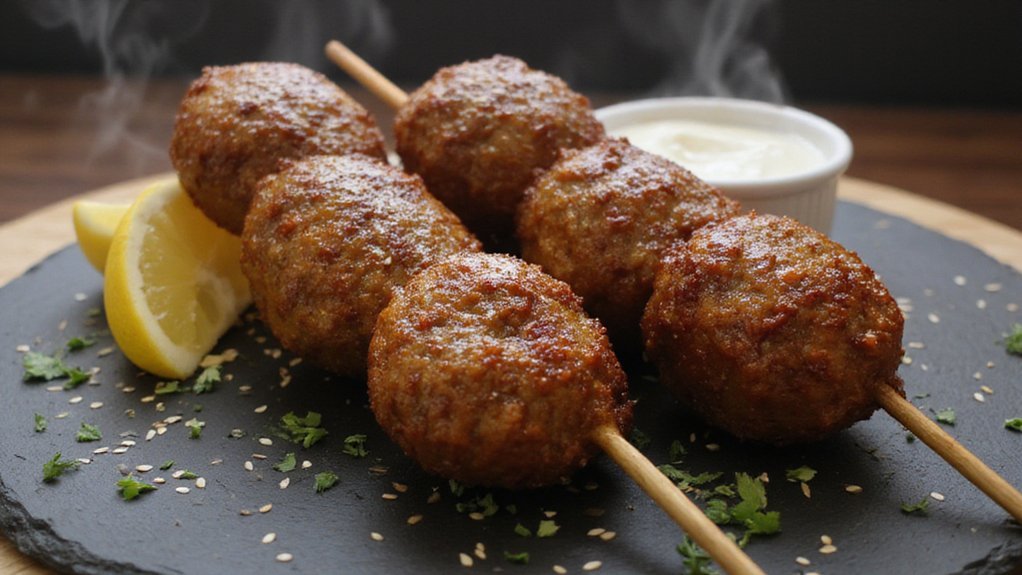


For experimental batches, log time, thickness, and surface caramelization to refine your protocol. These cooking temperature guidelines prioritize repeatability and safety while enabling controlled texture variation.
For innovators seeking nuanced results, follow these salmon doneness tips to calibrate your process and standardize outcomes across runs. Document ambient temperature and rack position to reduce variability consistently.
Flip and Check Doneness
Halfway through the cook cycle, flip each salmon bite once using tongs or a fish spatula to expose the opposite surface to convective heat and promote even browning; you’ll want the flip to be swift to minimize heat loss.
Use clean, steady flipping techniques: grip near the center to avoid tearing, rotate 180° in one smooth motion, and avoid overcrowding to maintain airflow.
After flipping, resume cooking and prepare for doneness testing. Probe the thickest bite with an instant-read thermometer; target 125–130°F (52–54°C) for medium-rare, 135°F (57°C) for medium.
Alternatively, press gently—salmon should yield slightly but not flake apart. If underdone, add 1–2 minute increments until target temperature is reached.
Rest briefly before serving to stabilize juices. Document results to refine future cook cycles.
Serving Ideas and Pairings
You’ll choose starches that balance the honey‑soy glaze: short‑grain sushi rice for adhesive texture, jasmine rice for aromatic lift, or farro and brown rice for nutty chew and superior sauce absorption.
Control grain portion and surface area so each salmon bite retains glaze concentration and textural contrast.
For beverages, pick an off‑dry Riesling or Grüner Veltliner to cut sweetness and enhance umami, or a crisp pilsner/amber ale to supply carbonation and malt backbone.
Rice and Grain Pairings
When pairing rice and grains with honey soy salmon bites, prioritize neutral, lightly textured starches that absorb glaze without competing with its sweetness and umami.
Choose rice varieties with controlled amylose levels—medium-grain for slight stickiness, long-grain for separated kernels—to modulate mouthfeel. Integrate alternative grains (sorghum, freekeh, barley) to introduce targeted chew and flavor scaffolding; test cook times and hydration ratios to match glaze viscosity.
You’ll calibrate grain textures to balance flake integrity and sauce adhesion: coarse grains hold more glaze, polished rice lets salmon dominate. Finish with minimal aromatics—toasted sesame, scallion oil—applied post-cook to preserve crisp edges.
Execute portion ratios (1:1 or 2:1) grain to fish depending on dish intent: snack, entrée, or shared plate. Adjust seasoning sparingly to maintain the glaze-driven flavor profile.
Wine and Beer Pairings
After calibrating grain textures to the glaze and flake integrity, choose beverages that mirror or counter the salmon’s sweetness, soy-derived umami and toasted sesame notes.
You’ll favor reductive white wine varieties—Chablis for steely acidity, unoaked Riesling with precise residual sugar, or Grüner Veltliner for white pepper lift—to cut oil and amplify glaze. For innovation, try light Pinot Noir or gamay for low-tannin, fruit-forward red contrast.
On the beer side, select beer styles with restrained bitterness and bright carbonation: pilsner for cleansing, saison for yeast-driven spice, or a session IPA with citrus hop clarity.
Serve slightly chilled whites and lagers, and cool reds lightly; adjust glassware to direct aroma toward the palate for ideal pairing.
Experiment with micro-vinification and craft-brew bottlings for novel matches regularly.
Storage, Reheating, and Make-Ahead Tips
If you plan to store leftovers, cool the salmon bites to room temperature within 30 minutes to limit bacterial growth.
Then portion in airtight storage containers, removing excess air to minimize oxidation; label with date and refrigerate at ≤4°C for up to 48 hours or freeze at −18°C for up to three months.
For reheating methods, prefer gentle convection: preheat the air fryer to 160°C, reheat for 3–5 minutes until internal temperature reaches 60°C, flipping once.
Alternatively, use a 120°C oven with a tray and splash of water to preserve moisture. Thaw frozen portions overnight in the refrigerator before reheating.
For make-ahead assembly, marinate and pat dry prior to flash-chilling; it’ll maintain texture and food safety without sacrificing flavor.
Monitor temperatures and use thermometers.
Tips, Swaps, and Variations
Although optional, precise tweaks to glaze concentration, cooking time, and oil selection materially change yield, texture, and browning.
So you should make substitutions proportionally and monitor temperatures. For healthy substitutions, swap regular soy for low-sodium tamari and replace honey partially with mashed ripe pear to retain fermentable sugars while reducing fructose; adjust glaze viscosity by 5–10% to maintain adhesion.
Use grapeseed or avocado oil to raise smoke point when increasing air-fry temperature for crisper exterior.
For flavor enhancements, add toasted sesame, citrus zest, or a calibrated chili paste; apply in a final 30–60-second blast to avoid burning.
Scale batch size linearly, validate internal temperature at 125–130°F for medium-rare, and document each variable for reproducible innovation.
Iterate rapidly, record results, and systematically refine your protocol.
Conclusion
You’ll appreciate these air fryer honey soy salmon bites for their efficient preparation, controlled Maillard development at 400°F, and reproducible texture: a crisp exterior with moist interior. Use low‑sodium soy, measured honey, and toasted sesame oil to balance osmotic and flavor variables. Follow timing and batch-size guidelines to prevent overcrowding and uneven doneness. Store refrigerated up to 48 hours; reheat briefly in the air fryer to restore surface crispness and internal temperature uniformity, consistently achieved.
About The Author