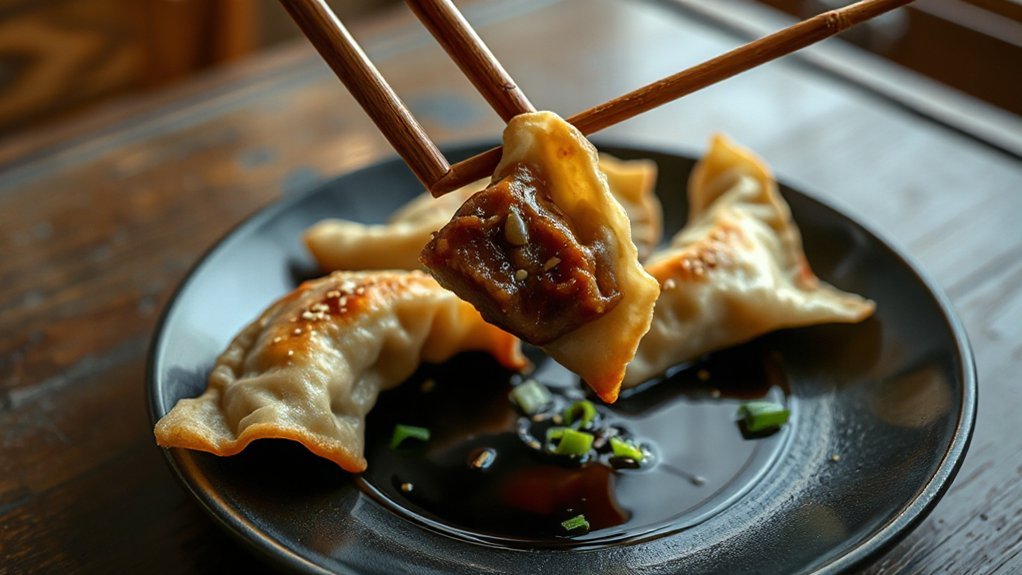
You get reliable crunch by pressing tofu, dusting it with cornstarch, and exposing it to high, dry heat in an air fryer. The cubes retain texture and pair cleanly with quick‑stirred vegetables and a soy‑forward sauce. Keep reading for the exact temperatures, timings, and sauce ratios you’ll use to reproduce this consistently.
Why Crispy Tofu Works in the Air Fryer

Because hot, rapidly circulating air strips surface moisture and drives Maillard reactions, the air fryer crisps tofu efficiently while using minimal oil.
You control temperature, airflow, and timing to optimize protein coagulation and surface dehydration, producing reliable crispy texture without deep frying.
You’ll exploit convection dynamics: high velocity air creates thin boundary layers that accelerate moisture loss and concentrate sugars and amino acids for browning.
You’ll use short, high-heat cycles and periodic agitation to avoid steaming and guarantee uniform crisping.
Air fryer benefits include reduced oil uptake, faster cycles, and predictable thermal profiles that scale from single portions to batch runs.
Implementing quantifiable variables—temperature setpoints, cycle durations, and agitation intervals—lets you iterate reproducibly toward desired mouthfeel and exterior crunch for consistent restaurant-grade results reliably.
Ingredients You’ll Need

When preparing this recipe, gather extra‑firm tofu, a neutral high‑smoke‑point oil, cornstarch (or potato starch) for coating, a soy‑based marinade or tamari, garlic, ginger, scallions, firm quick‑cooking vegetables (bell pepper, snap peas, broccoli), and optional finishers: toasted sesame oil, rice vinegar, chili paste, and sesame seeds.
You’ll prioritize essential ingredients that optimize texture, flavor absorption, and browning efficiency. Select extra‑firm or super‑firm tofu among tofu varieties for structural integrity during air‑frying. Measure oil precisely; use minimal amounts to reduce splatter while ensuring surface conduction.
Keep aromatics and sauces separate until after cooking to maintain crispness and control Maillard reactions. Have finishers ready to calibrate acidity, heat, and umami immediately post‑cook.
Scale quantities to yield consistent batches for testing and iteration on a gram scale.
Step-by-Step Prep and Pressing Tofu
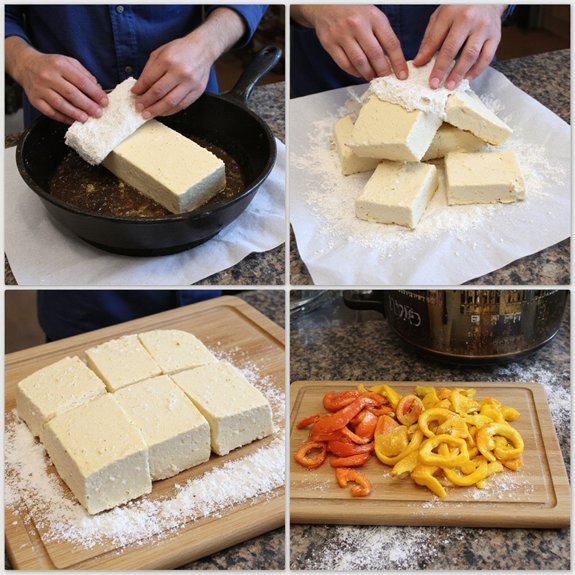
You’ve gathered the ingredients; now prepare the tofu for air‑frying by removing surface and internal moisture to improve browning and texture.
Pat block dry, slice into uniform cubes or slabs to guarantee even heat exposure. Line a tray with paper towels, stack tofu with additional towels and place a calibrated weight or heavy skillet atop for 20–30 minutes to extract liquid — this is standard tofu pressing.
After pressing, transfer pieces to a clean towel, re-pat to eliminate residual moisture. For innovation, briefly freeze then thaw to change internal structure and increase crisp potential.
Apply a light coating of oil and seasoning just before air contact. These preparation techniques optimize surface area, reduce steaming, and create reproducible results for the air fryer step.
Try variations.
Air Frying Instructions
Preheat your air fryer to 400°F (200°C) for 3–5 minutes so the basket reaches target temperature.
Air-fry the tofu at 400°F for 12–16 minutes, flipping or shaking the pieces once halfway (about 6–8 minutes) to guarantee even browning.
Adjust total time by cube size and desired crispness, checking for golden edges and a firm interior.
Preheat and Temperature
Before air frying, set the unit to 400°F (200°C) and let it reach temperature for 3–5 minutes so the tofu hits an even, hot environment on contact.
You’ll calibrate Air fryer settings to prioritize consistent convection and stable surface heat; confirm basket placement for unobstructed airflow.
Pat tofu dry and use a light coating of oil to promote rapid surface Maillard reaction that locks moisture and defines Tofu texture without saturation.
Use a digital probe or built‑in sensor to verify chamber stability before loading; temperature droop under load should be minimal.


If your unit cycles aggressively, increase preheat duration or reduce batch size to maintain peak performance.
You’ll replicate results across iterations and equipment reliably.
Timing and Flipping
Once the chamber stabilizes at 400°F (200°C), arrange tofu in a single layer with ≥¼-inch spacing so convection reaches all faces. You’ll air-fry for 18–22 minutes, testing at 12 minutes to calibrate for your model. Use a rapid flipping technique at mid-cycle to expose all edges; flip once with tongs to minimize coating loss. Timing importance is critical: shorter cycles yield softer cores, longer cycles increase dryness. Monitor color and internal texture rather than time alone. After flipping, resequence pieces to equalize exposure if needed. Rest 3 minutes; residual heat finishes firming.
| Parameter | Recommendation |
|---|---|
| Cycle | 18–22 min |
| Flip | Mid-cycle once |
| Rest | 3 min |
You’ll iterate parameters, logging model-specific cycles to refine crispness and mouthfeel for reproducible, innovative results across platforms and industrial scale deployment.
Quick Stir-Fry Sauce and Veggie Options
You’ll assemble quick sauces—soy-sesame, spicy hoisin, or citrus-ginger—by combining a salty base, a sweetener, an acid, and optional heat in roughly a 2:1:1 ratio.
Choose vegetable pairings that balance texture and cook time, e.g., thin bell peppers and snap peas for fast cooks or broccoli and carrots blanched first for sturdier mixes.
Toss air-fried tofu with sauce off heat and fold in delicate greens like spinach or scallions last to preserve color and texture.
Quick Stir-Fry Sauces
If you want a fast, balanced stir-fry, pick a compact sauce formula—soy (or tamari) for salt, a sweetener (mirin, honey, or maple) for balance, an acid (rice vinegar or lime) for brightness, and a fat (sesame oil or neutral cooking oil) for mouthfeel.
You’ll scale components 3:1:0.5:0.25 and adjust by weight for consistency. For heat, add chili paste or fresh chilies at 5–10% of total sauce. For viscosity, dissolve cornstarch 1:1 with cold water and use 2–3% of sauce weight; gelatinization occurs above 60°C.
For aromatics, infuse garlic, ginger, or scallion oil before combining. These quick sauce pairings accelerate development cycles and support systematic stir fry variations without extra prep.
Use batch templates, record ratios, and iterate. Track sensory metrics and timing precisely, consistently.
Veggie Pairing Ideas
Texture guides vegetable selection: match firmness, water content, and cut size to cooking time so your sauce ratio (3:1:0.5:0.25) and any cornstarch finish coat evenly.
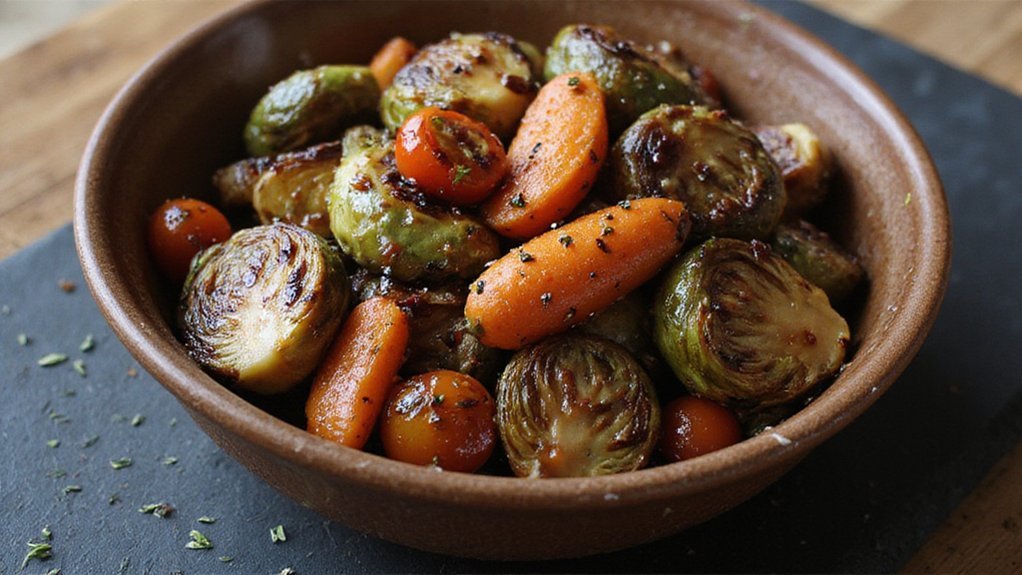
Choose Tofu varieties that withstand your chosen heat and Stir fry combinations that balance Texture contrasts and Color contrasts: use carrots and red peppers for bright, dense pieces; broccolini and snap peas for crisp, low-water bites; baby bok choy and mushrooms for tender, absorbent flesh.
Prioritize Seasonal vegetables to maximize Nutritional benefits and peak flavor.
Design Flavor profiles around umami, acid, heat, and sweetness, then adjust sauce viscosity and timing.
Apply precise Cooking techniques: high heat, rapid tosses, staging ingredients by density, and finishing with a cornstarch slip to bind and gloss the dish for optimized mouthfeel and nutrition.
Serving Suggestions and Meal Ideas
When plating the air-fryer tofu stir-fry, pair it with a high‑absorption carbohydrate—jasmine rice, soba noodles, or quinoa—to balance the sauce and provide body; keep vegetables crisp‑tender, add a bright acid (rice vinegar or lime) to cut oil, and finish with a nutty garnish (toasted sesame seeds or crushed peanuts) for textural contrast.
For meal prep you’ll portion components separately to control moisture transfer: store tofu crisp, vegetables chilled, and starch sealed; this preserves textures and extends hold time.
Determine serving sizes by caloric target and protein allocation; use a scale to standardize portions.
For inventive meals, layer the stir-fry into bowls, lettuce wraps, or cold noodle salads; you’ll vary temperature and mouthfeel without altering the base recipe.
Finish plates with microgreens for visual precision.
Tips, Troubleshooting, and Variations
Because air‑fryer performance varies, you should calibrate times and temperatures to your unit: verify with a probe thermometer and visual cues, and adjust for basket crowding and tofu piece size.
For consistent tofu texture, press tofu 20–30 minutes, cut uniform cubes (1–1.5 cm), and apply a thin oil coating; these controls reduce variability.
Monitor interior temperature and surface color mid-cycle; flip once to equalize crisping. If soggy, increase temperature by 10–15°F and extend cooking times in 2–3 minute increments, avoiding over-crowding.
For experimentation, try different coatings (cornstarch, rice flour, panko) and marinade osmotic treatments to alter moisture and flavor penetration.
Document your settings and outcomes; iterate systematically to converge on reproducible cooking times and desired tofu texture.
Record altitude and humidity for future adjustments.
Conclusion
You’ll find the air fryer delivers reliably crisp, high‑heat browning while preserving tofu’s interior texture. Pressing reduces moisture to enable rapid surface dehydration; cornstarch creates a thin, brittle crust. Air fry at 400°F in a single layer for uniform airflow. Stir‑fry vegetables briefly to maintain cell turgor and nutrient retention, then emulsify soy‑based sauce to coat pieces evenly. Use sesame oil and seeds for finishing aromatics and mouthfeel contrast. Serve immediately for ideal crunch retention.
About The Author