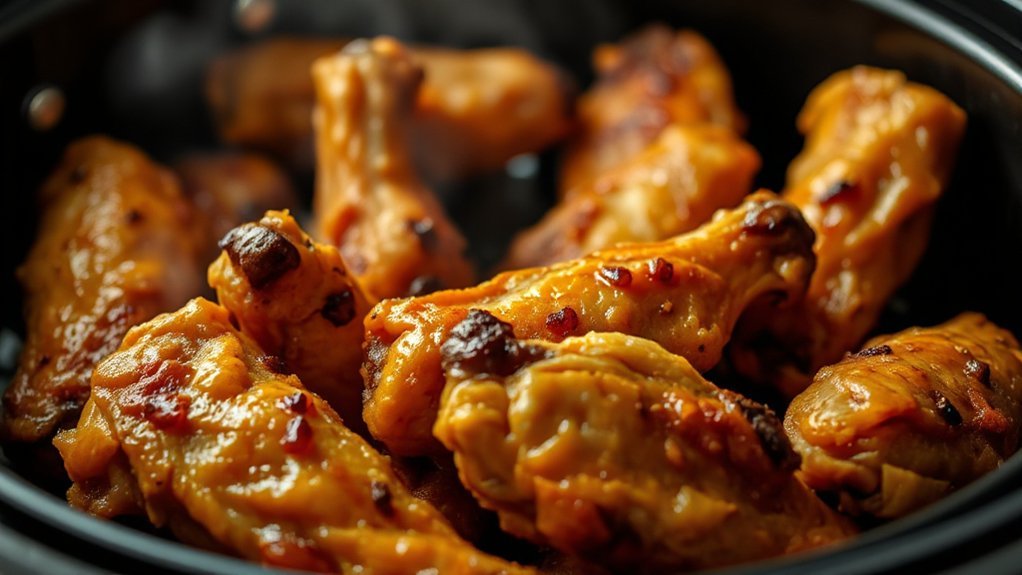
You’ll prepare 2 lb chicken wings, pat them dry, then season with 1 tsp kosher salt, 1/2 tsp black pepper and optionally 1 tsp baking powder. You let them air-dry 30–60 minutes. Preheat the air fryer to 400°F. Cook 18–22 minutes, flipping at 10 minutes. Test crispness and tweak time or powder to judge results — try a 400°F, 18–22 minute run to find out.
Ingredients and Tools
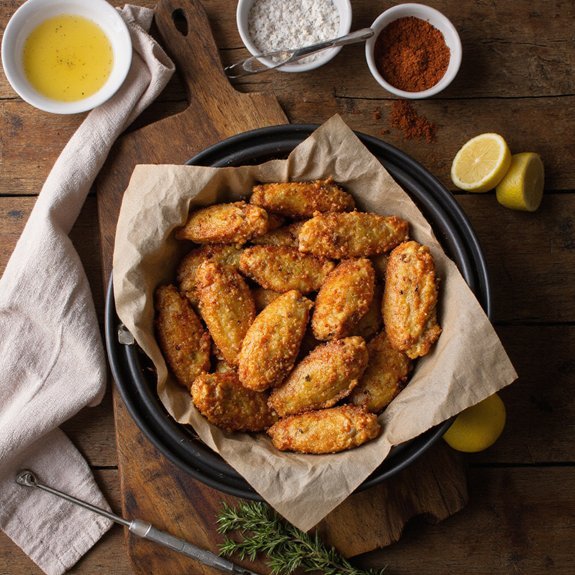
You’ll need 2 lb (900 g) whole chicken wings (about 12–14 pieces), 2 tbsp baking powder (aluminum-free), 1 tsp kosher salt, 1/2 tsp ground black pepper, and 1 tbsp neutral oil; optional: 1 tsp smoked paprika or cayenne for heat.
Gather: Air fryer rated for at least 3 qt, instant-read thermometer, wire rack, rimmed baking sheet, kitchen scale, measuring spoons, and tongs.
Specify wing types—drumettes and flats—and confirm count per batch to avoid overcrowding.
For testing, calibrate the Air fryer temperature with an oven thermometer and log cook cycles; run a 10-minute pilot at target temp to check airflow and crisping uniformity.
You’ll document adjustments after each run to refine texture, timing, and yield.
Preparing the Wings
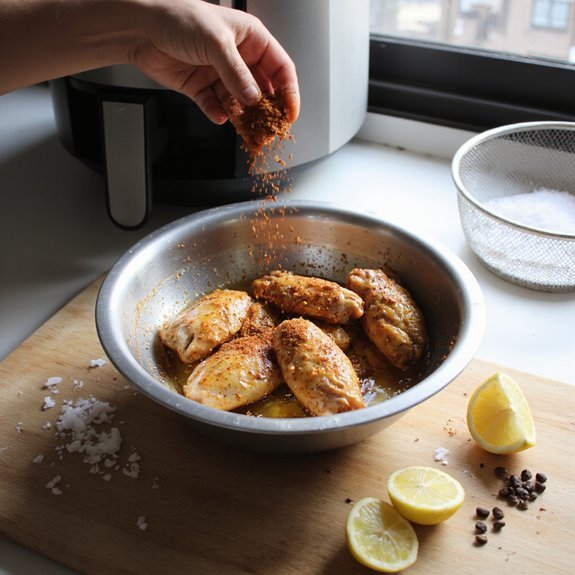
Trim wing tips and separate drumettes and flats, remove excess skin, and pat each wing dry with paper towels until no visible moisture remains (about 2–3 towels per 12 wings).
Season 1 lb (≈8–10 wings) with 1 tsp salt and 1/2 tsp pepper per pound or marinate in 1/2 cup buttermilk + 1 tbsp spice mix for 30 minutes to overnight; you’ll note stronger seasoning after 4+ hours.
For crispiness, arrange wings on a wire rack over a sheet pan and refrigerate uncovered 4–12 hours to air-dry; you can test readiness by comparing one wing’s weight before and after drying (expect ~5–10% loss).
Trimming and Patting Dry
Start by locating the joint between the drumette and the flat, then cut through the cartilage with a sharp chef’s knife or poultry shears to separate pieces and, if desired, remove wing tips at the distal joint for stock (reserve tips).
Use wing trimming techniques: trim excess skin and fat to 2 to 3 mm thickness and discard trimmings.
Pat each wing dry with paper towels, applying firm pressure for 20 to 30 seconds per side to remove moisture.
For scaled testing, weigh a sample of five wings before and after drying; expect a 5 to 8 percent reduction in water weight.
Optionally air-dry wings on wire rack in refrigerator, uncovered, for 1 to 3 hours to enhance skin texture.
Record results and iterate.
Seasoning and Marinating
Measure and sprinkle 1 tsp kosher salt and 1/2 tsp ground black pepper per 100 g of wings, then apply 1 tsp garlic powder and 1/2 tsp smoked paprika per 5 wings for baseline seasoning; don’t salt more than this until after a test cook.
| Method | Key Ratio | Test Note |
|---|---|---|
| Wet marinade | 2 tbsp soy : 1 tbsp honey per 250 g | Marinate 30–90 min |
| Dry rub | 1 tbsp sugar : 1 tsp spices | Rest 15 min |
| Citrus-brine | 1 cup water : 1 tbsp salt | Adjust acid 10% |
You’ll choose marinade variations or rub combinations, marinate or rub, test two wings, record salt, acid, and texture, then tweak salts by 10–20%. Log results, compare iterations, and converge on your preferred profile.
Air-Drying for Crispiness
After patting the wings dry with paper towels, place them skin-side up on a wire rack set over a rimmed baking sheet so air can circulate all around; don’t crowd—leave ~2 cm (3/4 in) between pieces.
For best results, refrigerate uncovered for 1–2 hours for passive air drying; test one wing at 60 minutes: the skin should feel tacky, not wet.
If you need faster moisture removal, use a fan directed at low for 30–45 minutes, keeping temperature below 4°C (39°F) if wings are refrigerated.
Weigh 2–4 wings before and after drying to quantify moisture loss; expect 3–8% reduction.
This controlled approach yields repeatable crispness in the air fryer and supports iterative tweaks to time and airflow.
Record results in a log for consistent experimental improvement.
Drying and Seasoning Tips
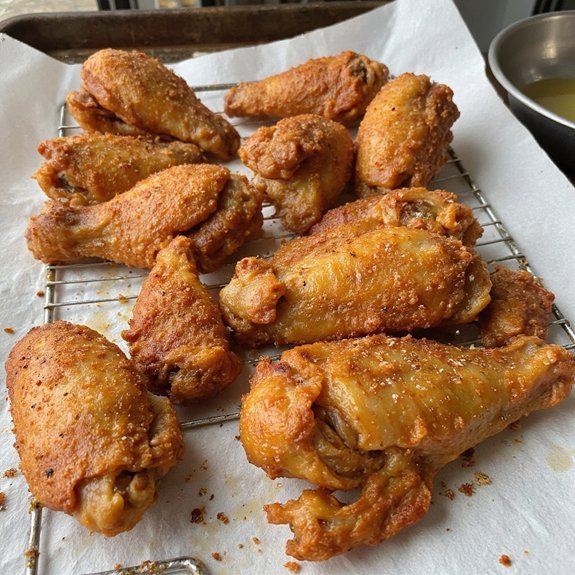
While the skin is still damp from rinsing, pat each wing thoroughly with paper towels and place them on a wire rack over a sheet pan so air can circulate; you’ll want them as dry as possible before seasoning.
For air-drying, leave wings uncovered in fridge 6–12 hours — test one after 6 hours for texture; surface should be tacky.
Use 1 tsp kosher salt per pound, ¼ tsp baking powder per pound for lift, and ½ tsp ground black pepper per pound.
For seasoning blends, mix 1 tsp smoked paprika, ½ tsp garlic powder, ¼ tsp cayenne per pound for baseline; adjust after a test batch.
Pat seasonings on, let rest 15 minutes, proceed to cooking.
Record results and tweak ratios by 10–20%.
Applying a Light Coating
Now that the skin is dry and the rub has rested, apply a light coating to help the surface crisp without masking flavors. Use 1 tsp neutral oil for 8 wings; toss in bowl until evenly glazed.
For a barely-breaded option, mix 2 tbsp rice flour + 1 tsp cornstarch per 1 lb wings and dust lightly, shaking off excess. Test one wing: you’ll see if coating hinders browning, and adjust to 1 tbsp flour next trial as needed.
Try alternative coating techniques: panko spray method (1 tbsp panko + mist oil) for experimental crunch, or skip flour and use 1 tsp baking powder for thin crisp.
Keep seasoning options simple — ¼ tsp salt per wing and incremental tweaks based on taste tests.
Preheating and Air Fryer Setup
Set your air fryer to 400°F (200°C) and preheat for 5 minutes; if the unit has no ready indicator, preheat 7 minutes or verify temperature with an infrared thermometer.
| Step | Check | Note |
|---|---|---|
| Load | Basket clean | Single layer |
| Oil | Spray 1 tsp | Even coating |
| Model | Test with infrared | Calibrate as needed |
Confirm basket clearance and airflow; leave 1/2 inch between wings and walls. For different air fryer models, note fan placement and adapt basket position. Use the preheating techniques above when testing crispness; document results and adjust oil quantity by 1/4 teaspoon increments. If using racks, verify even spacing with a probe thermometer. Record model, batch size, and sensor readings to refine reproducible results. Iterate and standardize your protocol for consistent, measurable innovation results now.
Cooking Times and Temperatures
Although air fryer models vary, target 400°F (200°C) for fresh wings and cook 18–22 minutes in a single layer, flipping at 10–12 minutes. You’ll aim for an internal temperature of 165°F (74°C) for safety and 175–180°F (79–82°C) for ideal crispness.

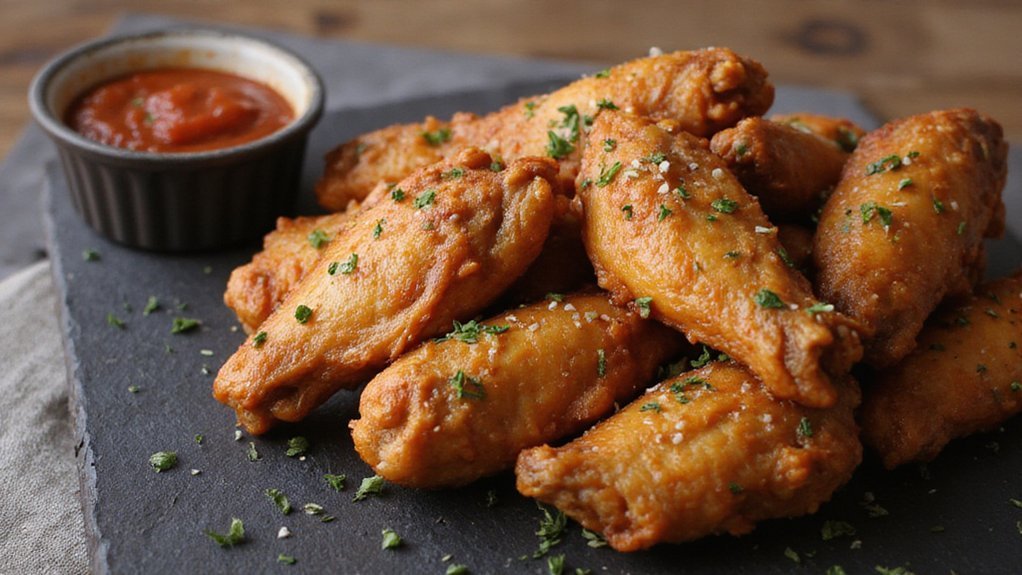

For frozen wings, raise cooking temperature to 400°F (200°C) and extend cooking duration to 22–28 minutes, testing doneness with an instant-read thermometer.
Calibrate your unit by timing a 6–8 minute test at 400°F with a single wing to verify heat-up and surface sear. Record cooking temperature, cooking duration, and achieved internal temperature for three trials, then adjust by ±2–4 minutes.
Use consistent wing size (3–4 oz) for reproducible results. Rest wings 3 minutes before serving. Document outcomes to refine your personalized cooking protocol regularly.
Flipping and Crisping Techniques
Flip once: flip fresh wings at 10–12 minutes and frozen wings at 11–14 minutes using metal tongs so the skin that was facing the basket now faces inward, keeping a single layer and leaving 1/2–1 in (12–25 mm) between pieces.
After flipping, resume at target temperature and monitor crispening every 3 minutes. Use Air flipping to minimize handling; perform smooth, decisive motions to avoid puncturing skin.
For Crisping techniques, increase temperature by 8–12°F (4–7°C) for the final 4–6 minutes, or extend time by 2–4 minutes if needed.
Test doneness with internal thermometer: 165°F (74°C). Note surface color, feel for resistance, and document each trial. Iterate settings until you reach repeatable, evenly browned results.
Adjust fan speed in prototypes when available to refine airflow patterns.
Sauce and Finishing Options
When wings register 165°F (74°C) and have rested 2–3 minutes, transfer 8 oz (225 g) of wings to a mixing bowl and add 2 tbsp (30 mL) sauce; toss briskly 20–30 seconds to coat evenly, then test adhesion on one piece—sauce should cling without pooling.
Scale in 8 oz (225 g) increments.
Try three sauce varieties: classic buffalo (2 tbsp hot sauce + 1 tbsp melted butter), honey-soy (2 tbsp honey + 1 tbsp low-sodium soy), and miso-maple (2 tbsp maple + 1 tsp white miso).
After tossing, you inspect surface for sheen and no runoff.
Finish with measured finishing touches: 1 tsp toasted sesame, 1 tbsp chopped scallion, or 1 tsp flaky salt.
Record results and adjust ratios by 0.25–0.5 tbsp for balance.
Serving and Storage Suggestions
You should plate about 6 wings per person with 100 g celery sticks and a 50 g blue‑cheese dip, arranging them on a shallow platter for easy grabbing.
You can offer three 60 ml sauce cups per 6 wings — buffalo (hot sauce:butter 2:1), honey‑Sriracha (honey:Sriracha 2:1), and garlic‑Parmesan (60 ml olive oil + 1 tbsp grated Parmesan) — so guests can test pairings.
Store leftovers in an airtight container at ≤4°C up to 48 hours or freeze at −18°C up to 2 months; reheat from refrigerated in a preheated oven at 200°C for 10–12 min or air‑fryer at 180°C for 6–8 min until internal temperature reaches 75°C, verified with a probe.
Serving Ideas
Serve 6–8 wings per person on a shallow platter lined with paper towels to absorb excess oil; arrange wings in a single layer with 1–2 inches between pieces so sauce coats evenly.
For testing, portion 8 wings with a digital scale (approx. 500 g) and note temperature retention after 10 minutes.
Offer measured dipping sauces, side salads, and 1/2 cup of crunchy slaw per person on the side; label containers and record preferences.
If you plate family-style, stagger batches every 6–8 minutes to maintain 165°F core and 200°F surface crispness; use a probe thermometer to confirm.
Store leftovers in airtight containers, cool to 40°F within 2 hours, and reheat at 375°F for 6 minutes to restore texture.
Test variations and log outcomes for refinement.
Sauce Pairings
If offering multiple sauces, portion 2 tablespoons (30 ml) per person in 2–3″ ramekins and provide 1/4 cup (60 ml) jars per 6–8 wings for family-style refills;
label each container with sauce name, batch date, and test ID.
For precise pairing, set up three station categories: acidic, savory, and heat—assign one sauce per category.
Measure 1:1 oil-to-acid for vinaigrette-based dips, 2:1 butter-to-hot-sauce for classic buffalo, and 3% sugar by weight for sticky glazes.
Document sauce combinations and flavor profiles in a log sheet with batch number, pH, viscosity, and tasting notes.
When testing, taste in consistent order, cleanse palate with unsalted crackers, and record consensus.
Use these protocols to iterate rapidly and scale successful pairings.
Rotate recipes monthly and tag winners for replication testing.
Storage and Reheating
After labeling sauces and batching wing lots, pack sauced wings separately from dry/crisped wings: store sauces in 60–120 ml jars and wings in shallow, single-layer containers (use 1–2 lb / 450–900 g per container) to cool faster.
For short-term storage, refrigerate at 1–4°C and use within 3 days; for long-term, freeze in 375–500 ml vacuum bags for up to 3 months. When refrigerating wings, leave lids ajar for 30 minutes then seal to avoid steam buildup.
Reheat crisped wings at 200°C in the air fryer for 4–6 minutes, sauced wings at 160°C for 6–8 minutes to preserve glaze. Test internal temperature to 74°C.
Label storage containers with date, sauce type, and test batch notes. Adjust times based on wing size and your air fryer.
Troubleshooting Common Issues
When wings turn soggy, check three variables and test adjustments: pat wings completely dry with paper towels (no visible moisture), toss 1 tsp baking powder per 450 g (1 lb) of wings evenly, and arrange them on a rimmed baking sheet spaced at least 2.5 cm (1 in) apart.
If you see undercooked wings, increase air-fryer time in 2-minute increments and retest internal temperature to 75°C (165°F). For overcooked wings, reduce time by 1–2 minutes or lower temperature by 5°C (10°F) and run a short trial.
Address uneven crispiness by flipping halfway, avoiding fryer overcrowding, and rotating trays. Fix seasoning imbalance by measuring salt and spice per 450 g (1 lb).
Track results and iterate until consistent. You’ll document changes and compare quantitative outcomes.
Conclusion
You’ll get repeatable results by following this method: pat 2 lb wings dry, toss with 1 tsp kosher salt, 1/2 tsp black pepper and 1 tsp baking powder, then air-dry 30–60 minutes. Preheat to 400°F and cook 18–22 minutes, flipping at 10 minutes. Test doneness with an instant-read thermometer (165°F) and for crispness, poke and assess texture; add 2–4 minutes if needed. Store leftovers refrigerated up to 3 days. Reheat at 375°F for 6 minutes.
About The Author